
The Jobs AI Is Killing in the Gulf That Nobody Is Talking About

How automation is quietly reshaping the GCC's expat workforce — and what workers can do about it
The global conversation about AI and job displacement centers almost entirely on Silicon Valley engineers and Western knowledge workers. But 2,000 miles away, in the gleaming towers of Dubai, Riyadh, and Doha, a quieter displacement is happening and the workers absorbing the impact have almost no safety net.
Millions of South Asian expats — from India, Pakistan, Bangladesh, Nepal, and the Philippines — have built their lives around administrative and coordination roles in the Gulf. Data entry clerks, document processors, call center agents, payroll coordinators, financial reconciliation specialists. These roles powered the Gulf's economic machine for decades. And right now, they're being systematically eliminated.
The Scale Is Hiding in Plain Sight
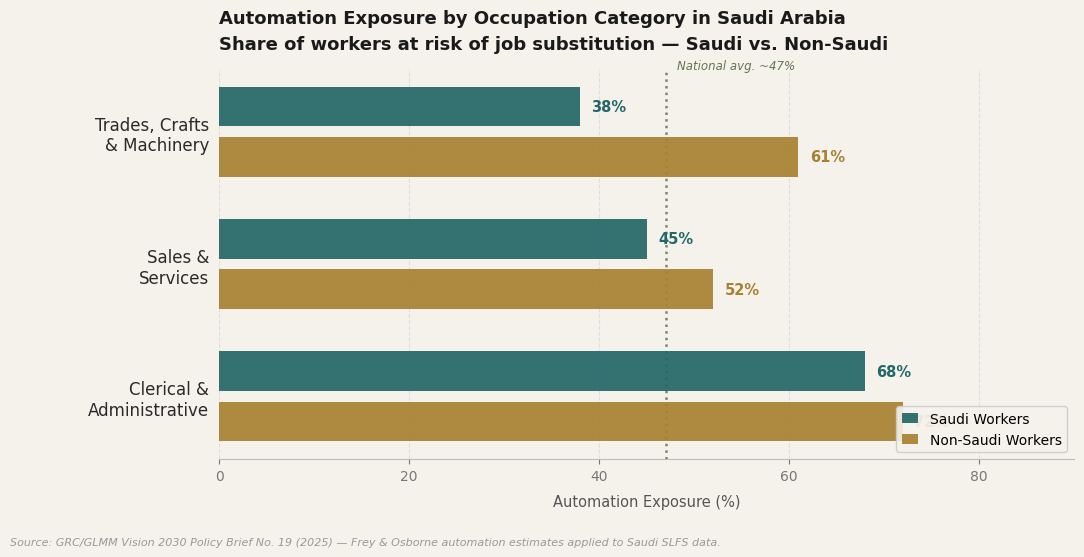
The numbers are not ambiguous. Studies suggest AI and automation could replace 20 to 50% of current jobs in the Gulf over the next decade, with administrative support, manufacturing, and transportation identified as the most vulnerable sectors. In Saudi Arabia alone, approximately 47% of all jobs face some degree of automation exposure, with non-Saudi workers — who dominate sales, services, and operational roles — carrying an automation risk of around 52%.
The cost of inaction is already visible. Career transition inefficiencies and automation disruption cost the Saudi economy an estimated SAR 196 billion (approximately 4.2% of GDP) annually when losses to non-Saudi workers are included. That's not a future projection. That's money leaving the system right now.
The Specific Roles Being Quietly Eliminated
Let's name the jobs that are disappearing — not in theory, but in actual GCC payrolls right now.
Call Center Agents and Quality Monitors
GCC contact centers are rapidly shifting from sampled quality assurance to AI-driven 100% call scoring. Systems that once required entire floors of QA analysts now run on natural language processing tools that flag risk, non-compliance, and coaching opportunities automatically. The human layer isn't being "augmented" — it's being removed.

Data Entry and Document Processing Clerks
Robotic Process Automation (RPA) tools now handle data entry, invoice processing, reconciliation, and compliance checks with measurably lower error rates than human operators. Banks, logistics companies, and government-adjacent entities have deployed these systems at scale. A back-office team of 30 can become a team of 5 overnight.
Basic Financial Reconciliation Specialists
McKinsey estimates AI could boost banking sector productivity by 40% by 2030, and GCC banks are already reporting drastically faster loan decisions and fraud detection. Emirates NBD and other regional banks are not just automating tasks — they're restructuring entire departments. The reconciliation clerk sitting at a spreadsheet is the poster child for this transition.
HR Coordinators and Recruitment Screeners
Generative AI is automating resume screening, payroll pulse scoring, and onboarding coordination. Around 52% of UAE employers planned to deploy generative AI in HR workflows by mid-2026. The entry-level HR coordinator role — historically a common pathway for expats — is compressing fast.
Administrative Assistants in Government-Adjacent Roles
The UAE's Emiratization push is being supercharged by AI recruitment platforms like Massar Al Ghurair and the Emirati Smart Human Resource Platform, which use AI to match candidates, conduct virtual interviews, and generate hiring dashboards. As these platforms consolidate recruitment workflows, the admin staff who previously managed those processes manually become redundant.
The Visa Trap Nobody Mentions
Here's what makes this displacement categorically different from what's happening in London or New York: the kafala system.
Under the Gulf's sponsorship visa model, a worker's legal right to remain in the country is tied to their employer. When a role is eliminated, it's not just a job loss — it's a countdown clock on residency. Workers typically have 30 to 60 days to find a new sponsor or leave the country. There's no unemployment benefit, no retraining stipend, no social safety net.
The worker who spent 7 years as a data processing clerk at a Dubai logistics firm doesn't just lose income when automation hits. They lose their apartment, their children's school, and their right to be in the country.
Which "New Roles" Are Real and Which Are Theoretical
Government statements across the GCC are optimistic. The UAE AI Minister has stated, "Our goal is adaptation, not displacement", and the World Economic Forum projects AI will create 97 million new jobs globally by 2025. The UAE has committed $135 million to AI education programs, and Saudi Arabia's 23% automation risk is being framed as a reskilling opportunity.
But let's be honest about the gap between those narratives and reality.
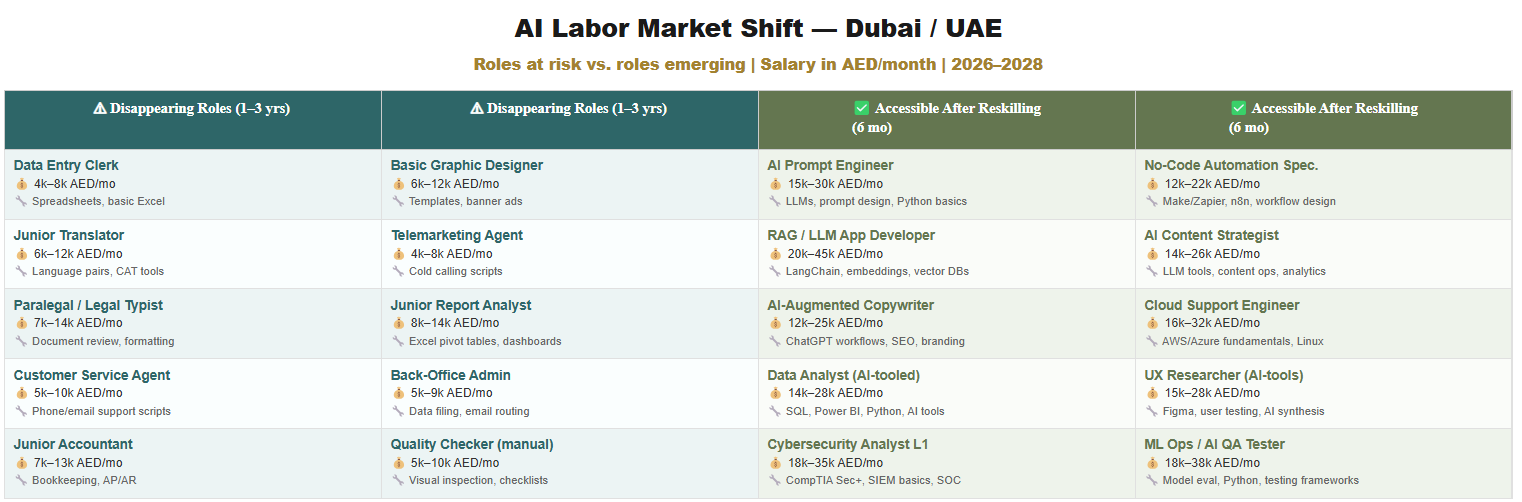
Roles that are genuinely absorbing displaced workers:
- AI-assisted customer service supervisors — there is real, documented demand for humans who manage AI systems rather than perform frontline tasks
- Data labeling and annotation contractors — lower-skill entry point into the AI pipeline, though wages are modest
- Logistics coordination with digital tools — demand for workers who can operate AI-augmented supply chain platforms, not replace them
Roles that are largely theoretical for current displaced workers:
- "AI trainers" — these require significant upskilling; as the field is just appearing, some prompt engineers in the UAE earn up to AED 36,000 annually
- Cybersecurity and ethical AI governance — important growth sectors, but not accessible without formal reskilling programs that take months to years
- Creative and strategic roles — real demand, wrong skill profile for most at-risk workers
The honest answer is that the gap between "jobs being lost now" and "jobs being created" is bridged by time and training — and for expat workers on tight visa timelines, time is the one resource in shortest supply.
A Realistic AI-Resilience Strategy for Vulnerable Workers
If you're currently in a data entry, reconciliation, call center, or admin coordination role in the Gulf, the window to act is not 2030 — it's now. Here's what a grounded strategy looks like.
1. Audit your actual skill stack, not your job title.
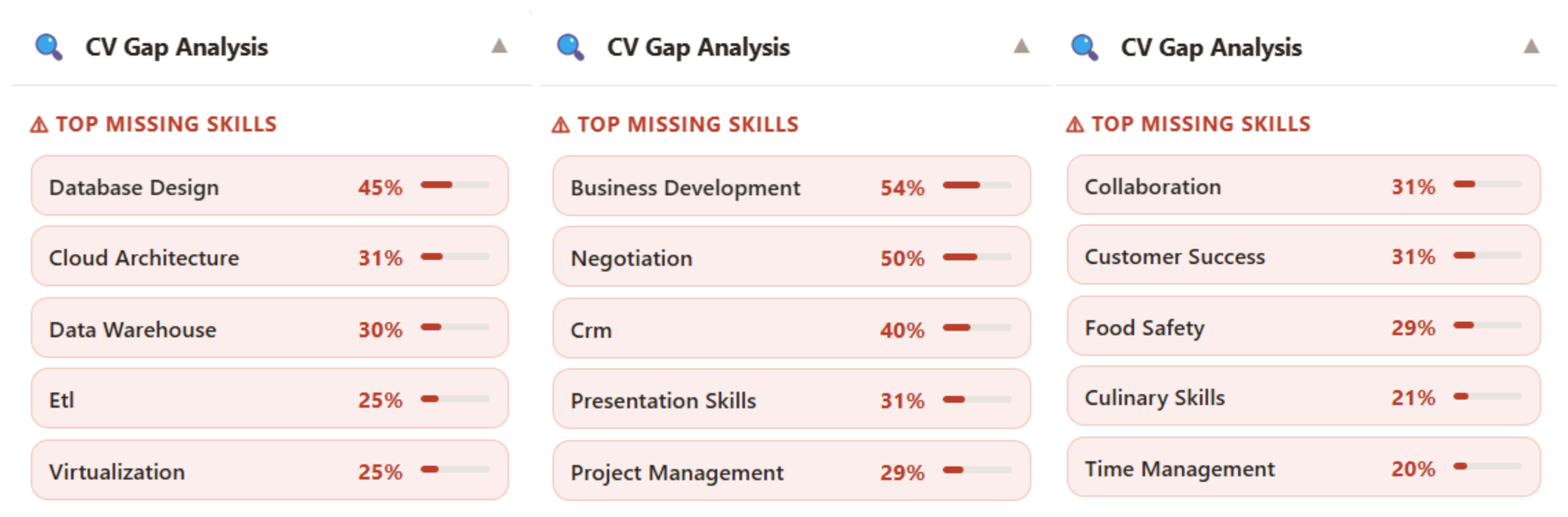
Your job title is what's being automated. Your underlying skills — communication in multiple languages, attention to document detail, process knowledge of specific industries — may be more portable than you think. The problem is that most CVs don't surface these transferable assets correctly. Tools like Falahly.com are built specifically for this moment: upload your CV and get a clear-eyed map of which skills are genuinely in-demand versus which ones are invisible or oversold. When your job category is under threat, the framing of your existing experience is everything.
2. Identify the adjacent roles one step up the automation stack.
The goal isn't to compete with AI — it's to move one layer above it. A data entry clerk who learns to validate, QA, and manage an RPA pipeline becomes the human-in-the-loop that organizations still need. A call center agent who develops escalation management and AI-flagged complaint resolution skills moves from replaceable to essential.
3. Prioritize certifications that signal transition, not just knowledge.
In the GCC job market, certifications from recognized platforms (Google, Microsoft, Coursera's industry programs) function as credibility signals for hiring managers who are unfamiliar with your background. A 3-month data analytics certificate doesn't make you a data scientist — but it signals intent and capability in a way that a static CV doesn't.
4. Reposition before you have to, not after.
The worst time to update your CV and start job hunting is after your role has been eliminated and your visa clock is ticking. Treat the current moment — while you're still employed — as your runway. Falahly.com can show you not just which jobs match your current profile, but specifically what gaps are holding you back from the next tier of roles. That's the intelligence you need to act on now, not in six months.
What Governments Are Doing — and What They're Missing
The UAE's $135 million AI education commitment and Saudi Arabia's Vision 2030 reskilling pipelines are real investments. The UAE ranked third globally for net AI-talent migration in the Stanford AI Index 2025 — a sign that the country is successfully attracting high-skill AI workers from abroad.
But here's the structural irony: the same policy architecture that's accelerating automation (Vision 2030's push for digital efficiency, UAE's National AI Strategy 2031) is also failing to protect the workers most exposed to it. Emiratization and Saudization policies are actively prioritizing local nationals for the new roles being created, which is a legitimate policy goal — but it means displaced expat workers are doubly squeezed: their old roles are automated away, and the new roles are being reserved for citizens.
This isn't a criticism. It's a reality that expat workers need to understand clearly when planning their next move.
The Conversation We Should Be Having
The Gulf's AI displacement story isn't making global headlines because the workers absorbing the shock don't have political voice in the countries where they work, and their home governments are largely focused on remittance flows rather than labor quality protections.
But for the individual worker — the accounts assistant in Sharjah, the data coordinator in Jeddah, the call center team lead in Doha — the disruption is entirely personal and entirely immediate. The window to pivot is real, but it's not infinite.
The most dangerous position to be in right now is not "low-skill." It's uninformed. Workers who understand exactly what skills they have, what the market actually wants, and what specific gaps they need to close are the ones who navigate transitions successfully. That's precisely the intelligence gap that platforms like Falahly.com are designed to close — not with generic career advice, but with specific, CV-level analysis that tells you what to keep, what to cut, and what you're underselling.
The automation wave isn't stopping. But neither is human adaptability — if it's pointed in the right direction.
The hiring process has a new first gatekeeper. It doesn't get tired, it doesn't feel your passion, and it doesn't give partial credit for effort. But it is knowable — and that's your advantage. Use it.
Ready to see how your CV scores? Upload it at Falahly.com and find out what the AI would say about you right now.
About Falahly: Falahly.com helps professionals find new opportunities and understand exactly how their CV maps to the current job market. You'll be able to identify the closest-matched roles, understand the gaps that are costing you interviews, what to throw out, and what to put front and center. In a market being restructured by AI, precision matters more than ever.