
Amazon Just Sent Me a Rejection as a Job Requirement
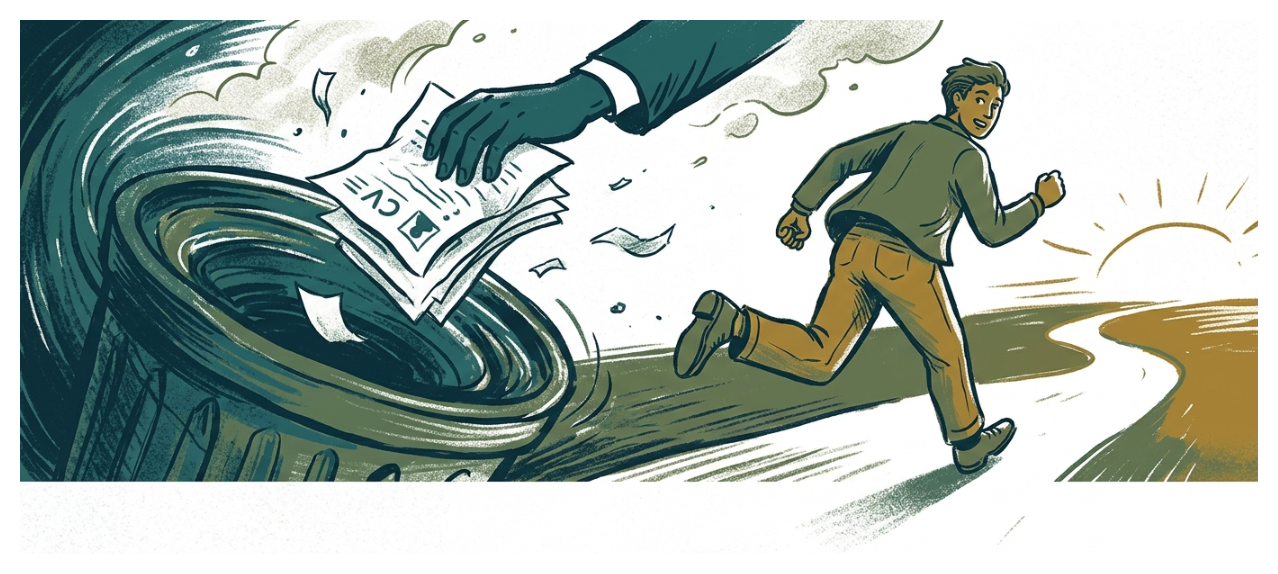
A viral glitch, a timeless lie, and what smart job seekers in the Gulf should do instead
The Bug That Became a Mirror
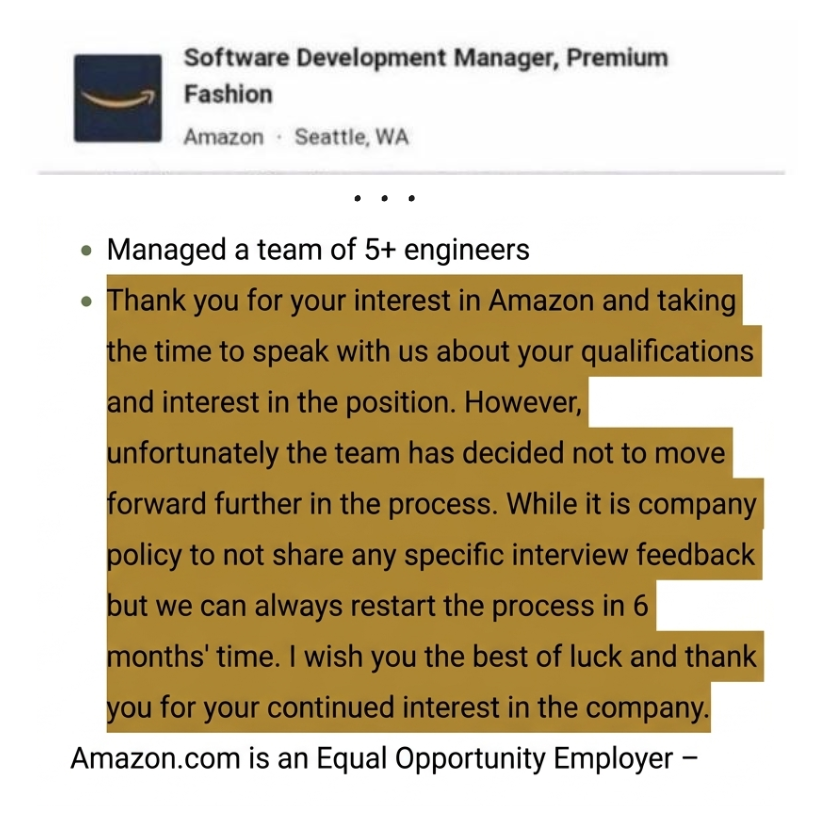
It started as a joke. A screenshot circulated across LinkedIn and Reddit showing an Amazon job listing that had — accidentally, presumably — included the company's own rejection email template as one of the job's bullet-point requirements. The post exploded. Comments ranged from "at least they're honest upfront" to "this is what automated HR looks like from the inside out."
Funny? Absolutely. Alarming? Even more so.
Because this isn't just a copy-paste blunder. It's a window into how broken automated recruiting has become — for candidates and for companies. When your job listing accidentally includes the email you send to people you don't want, you've stopped thinking of applicants as humans. You've turned them into variables in a pipeline.
And that pipeline is coming to the Gulf — fast.
The Machine Is Already in the Room
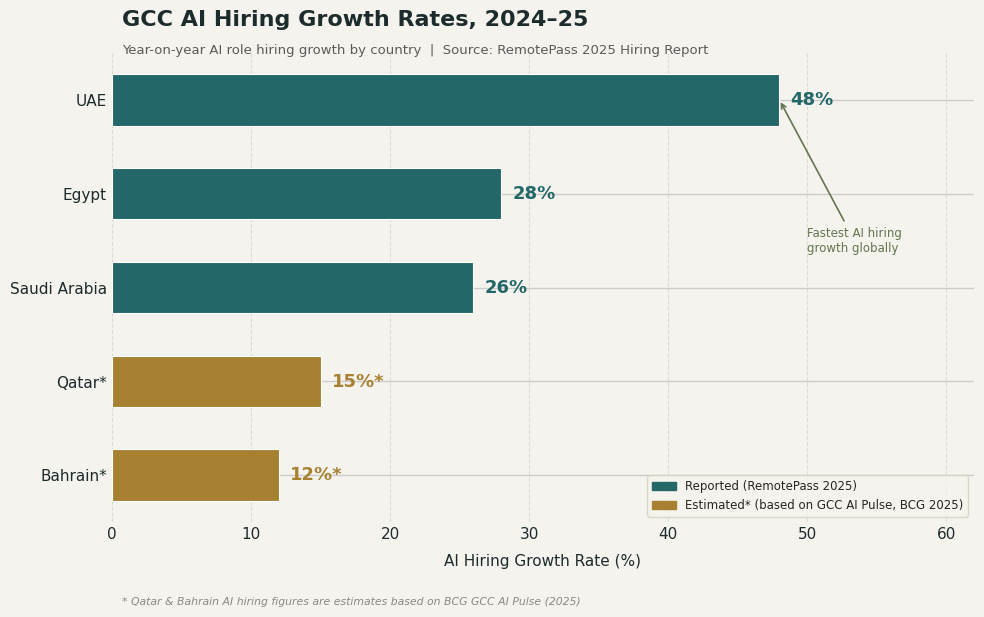
The UAE now leads the world in AI hiring growth, with a staggering 48% year-on-year increase in AI-related roles from 2024 to 2026. Saudi Arabia follows at 26%. Demand for data scientists rose 43%, AI product managers 37%, and AI engineers 31% in the same period. Gulf companies aren't just hiring for AI — they're using AI to hire, adopting automated screening tools, chatbot pre-interviews, and algorithmic résumé filters at a pace that outstrips their ability to implement them thoughtfully.
The result? Candidates are being filtered out before a human ever sees their name. Entire careers compressed into a keyword match score. And somewhere in Riyadh or Dubai, a hiring manager is unknowingly pasting a rejection email into a job description — they just haven't been caught yet.
Why Automation Is Making Candidates Feel Like Tickets
This isn't just vibes. According to a survey by Express Employment Professionals, 84% of job seekers prefer having a real person review their application rather than AI alone. Yet companies keep automating. Recruiters admit it themselves — 40% of hiring professionals now worry that AI is making their processes "too impersonal" and "robotic".
Read the complaints and a pattern emerges: AI interview chatbots that "welcome you by name and then ghost you". Interviewers who haven't read your CV asking you to recap it out loud. Rejection emails so templated they accidentally end up in the wrong document. One Reddit user put it simply: "AI recruiters are the most dehumanizing thing I've ever experienced — it felt like talking to a wall".
The systems designed to make hiring faster have made it noisier, less human, and less reliable for everyone. Trust breaks down on both sides. Candidates ghost companies back — 76% of recruiters report being ghosted by candidates they reached out to. The arms race has no winner.
Gulf Companies: You Are Not Immune
With competition for talent intensifying — Dubai and Riyadh are seeing staff turnover rise above the traditional 7–10% range as employees demand higher salaries against rising costs of living — the pressure to automate hiring is real. More applications, less time, leaner HR teams.
But copying broken Western workflows without adapting them to Gulf market realities is a trap. Here's why:
- Relationships still dominate Gulf hiring. In Dubai, Abu Dhabi, and Riyadh, a warm introduction from a shared connection moves faster than any ATS (Applicant Tracking System) filter.
- The talent pool is deeply international. Over-relying on keyword-match algorithms screens out qualified candidates whose CVs use different regional terminology for the same skills.
- Brand reputation travels fast. In a market as interconnected as the GCC, a single viral "dehumanizing experience" story spreads across WhatsApp groups, LinkedIn circles, and industry events before your PR team finishes their coffee.

Now Let's Talk About Your Side of the Broken System
You've heard it. Every Gulf job seeker has heard it. You follow up after an interview and the recruiter says, warmly, almost apologetically:
"We'll keep your CV on file."
They won't.
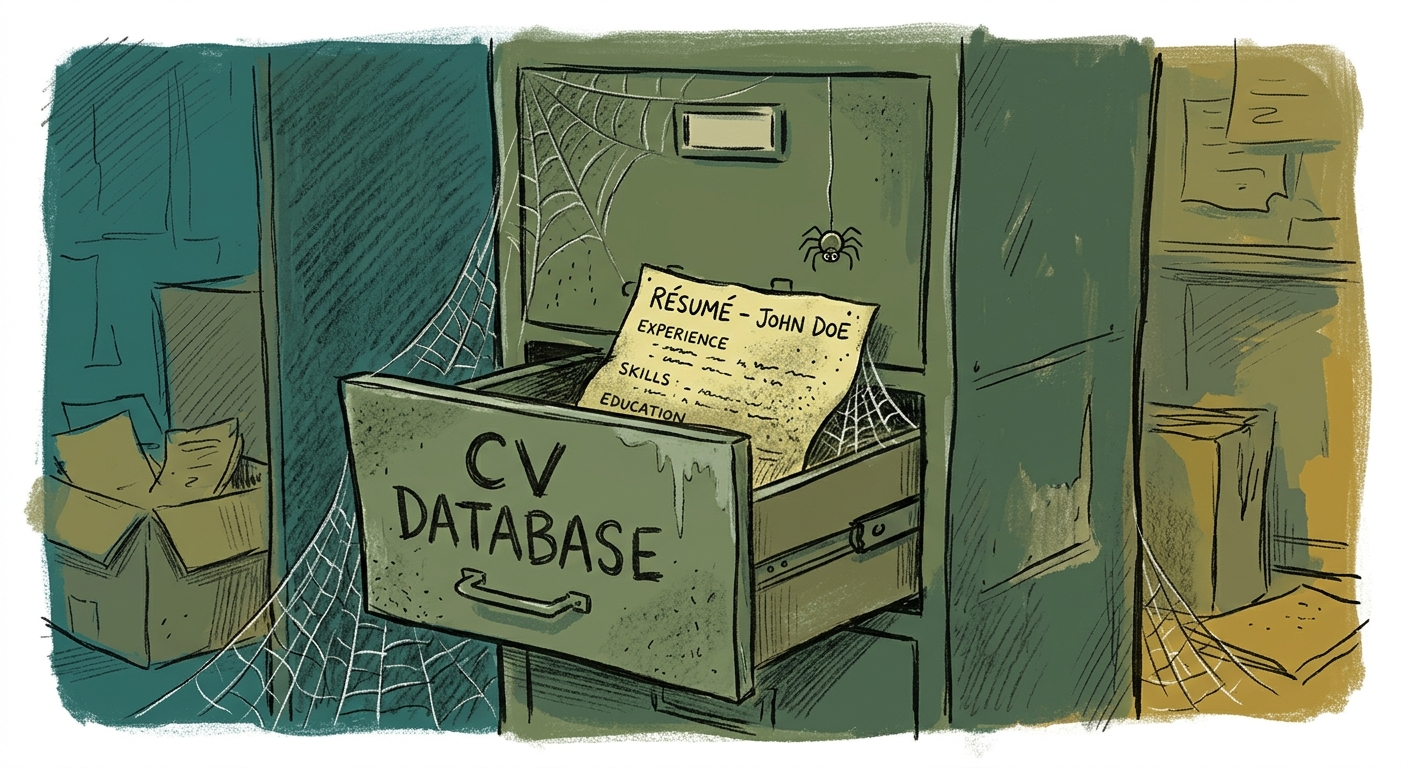
Let's be precise about what "on file" means in practice: your PDF lands in a shared drive folder called something like Applications_2025_Q1, which no one opens again until it's time to delete old files and free up storage space. It is a polite way of saying no while leaving you feeling like a maybe. It is the job-search equivalent of "I'll call you" — and it deserves to be treated exactly the same way.
What Actually Works in the Gulf Job Market
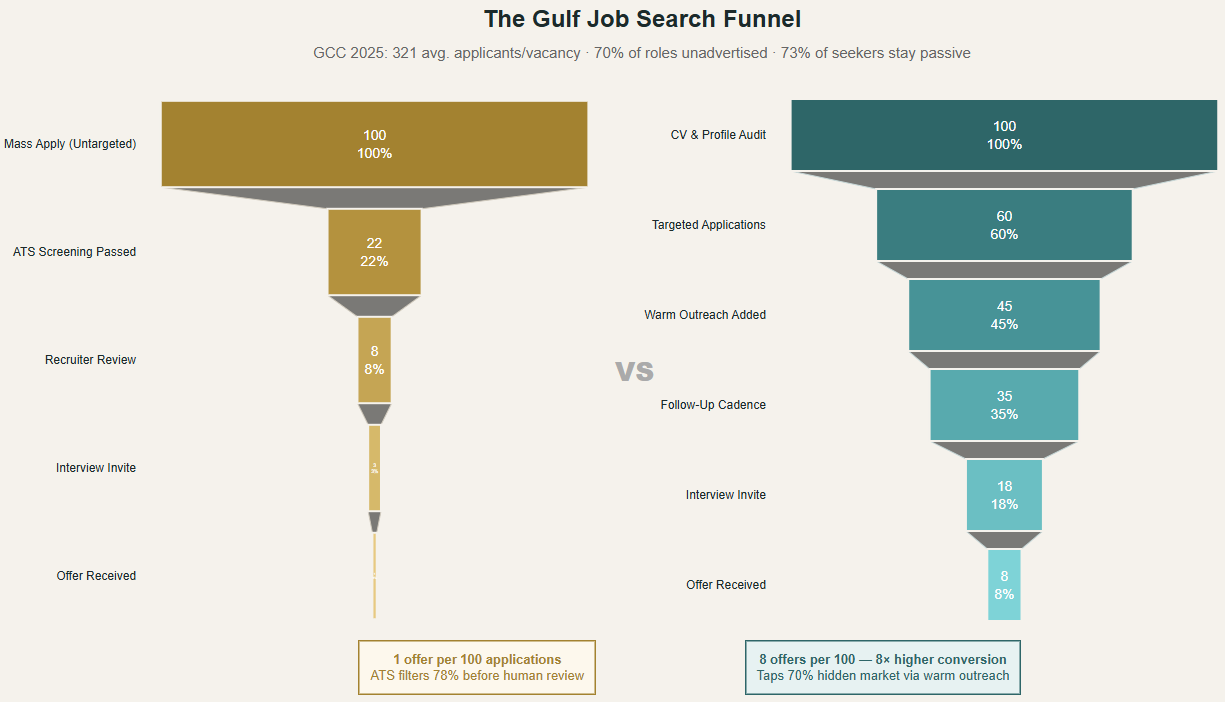
Stop waiting. Start engineering your own pipeline. Here are five moves that replace passive hope with active momentum — specifically calibrated for Dubai, Riyadh, and Abu Dhabi.
1. Get clarity on what your CV is actually saying (and missing)
Before you send another application, you need an honest audit. Tools like Falahly analyze your CV against real job listings, show you exactly which roles you're closest to, flag the gaps recruiters will silently reject you for, highlight what to remove (that 2009 internship isn't helping you), and tell you what to emphasize. You can't fix what you can't see.
2. Build a warm network before you need it
The Gulf job market runs on introductions. Start attending industry events — in Dubai, that means GITEX, Step Conference, and sector-specific meetups in DIFC and D3. In Riyadh, align with Vision 2030 ecosystem events. Connect before you're desperate. Recruiters remember who was genuinely engaged versus who appeared only when jobless.
3. Target companies, not job boards
Identify 15–20 companies you genuinely want to work for. Follow their leadership on LinkedIn. Comment thoughtfully on their posts. Send a short, direct connection request to the hiring manager — not "I'm looking for opportunities" but "I noticed your team is expanding into [X area], I work in that space and would love 15 minutes to exchange ideas." This works because it bypasses the ATS entirely.
4. Follow up on rejections — once, professionally
Reply to rejection emails. Seriously. Most candidates don't. A brief, gracious note — "Thank you for the update. If a role opens up in [specific area], I'd welcome the chance to reconnect" — puts you in a category of roughly 3% of candidates. Companies hire the wrong person, people quit, roles reopen. The person who replied thoughtfully gets the call.
5. Make your CV searchable for the right role — not every role
A CV trying to be everything gets filtered out for being nothing specific. Use Falahly to identify which two or three job categories your background best matches, then tailor your CV specifically for those. A targeted application with 80% keyword alignment beats a generic application with 50% alignment every single time.
The Uncomfortable Truth About AI Recruiting — And What Comes Next
AI in recruiting is not going away. Nor should it — when used well, it genuinely helps match the right candidates to the right roles faster. The problem isn't the technology. It's the lazy implementation: copy-pasting processes from a different market, skipping the human checkpoints, and treating candidates as inputs rather than people.
Amazon's accidental rejection bullet point is funny precisely because it pulls back the curtain. Somewhere in that company's hiring workflow, someone built a template, someone automated an action, and no human reviewed the output before it went live. That's not an AI failure. That's a process failure that AI made visible.
Gulf companies have a genuine opportunity here. You're earlier in the adoption curve. You can build AI-assisted hiring that keeps humans in the loop — that uses automation to surface candidates, not decide on them. That difference will determine whether your employer brand becomes a competitive advantage or a LinkedIn cautionary tale.
In the meantime, if you're a job seeker waiting for someone to find your CV "on file" — stop. Take control of your search. Know what roles fit your background, know what your CV is missing, and go get them. Falahly was built for exactly that: showing you where you stand, what to fix, and which doors are actually worth knocking on.
Because the best time to stop hoping someone will find your CV is now.
📌 Share this article if you've ever been told "we'll keep your CV on file" — and nothing ever came of it.
About Falahly: Falahly.com helps professionals find new opportunities and understand exactly how their CV maps to the current job market. You'll be able to identify the closest-matched roles, understand the gaps that are costing you interviews, what to throw out, and what to put front and center. In a market being restructured by AI, precision matters more than ever.